Versions of China: A Travel Reflection
Somewhere between Chengdu and Beijing, I realised that along with traveling I was complementing my experience of China through the books I’d brought along with me: one on my e-reader (I have the hardcopy but opted to travel light since it’s a tome and this was lucky because it turned out to be a banned book in China), and one as a light and slim hardcopy.
I started reading Wild Swans by Jung Chang before I left for China and finished it while there. I followed that up immediately with To Live by Yu Hua. I selected these books before my trip after reading a random post on what to read to ‘understand China better.’ Though it was mostly random how I selected these two books from that list, it began to feel intentional while on my trip. These aren’t just two books about China but rather, they are two book that represent two ways of remembering it. And then, layered on top of both, there was a third version: the one I was being shown as a visitor, through tours, visiting sites with museums, and conversations. I was also arriving with a version of China shaped by the internet, through short-form videos, aestheticised fragments of culture, and the kind of global trends that flatten complexity into something consumable. It made me wonder how I would feel seeing parts of my own culture, being part of the Indian diaspora, reduced in the same way: packaged, stylised, and circulated into bite-sized content without context.
Wild Swans is the story of three generations of women in Jung Chang’s family. Her grandmother grew up in pre-communist China, in a time when women had bound feet and could be given to warlords as concubines. Her mother became a senior Communist Party official. And Jung Chang herself lived through the Cultural Revolution, which forms the most intense part of the book. The descriptions of that period are horrific, going on for years and resulting in countless deaths. What struck me most was that nobody was safe. People who had been high-ranking Communist officials suddenly found themselves branded enemies, sometimes by their own children, and many were driven to suicide.
To Live, published a couple of years later in 1993, is revered as a classic in China. It’s about Fugui, a man who goes from the top of the food chain to the lowest of the lows, while China itself is changing completely around him. The writing is very straightforward. It is simple to read but the story itself is hard to swallow. You see struggle at every phase of life, in so many different forms. Frankly, it’s devastating.
Reading Wild Swans before To Live did me the service of understanding more of the cultural and historical dynamics that Yu Hua refers to more subtly. For instance, I knew about the Cultural Revolution but Wild Swans gave it context through the story of one family’s immense struggles as class structures were turned upside down and as revenge and suspicion became embedded in everyday life. Learning about these details made moments in To Live come to life. For instance when a village authority figure was suddenly humiliated, attacked and tortured by young people who have just come to power in the city, it’s contextualised by the understanding of how class dynamics were completely flipped and how it impacted everyone’s lives intimately.
That being said, the books operate completely differently. One is a memoir insistent on documenting history, political and personal. The other is fiction; it is so straightforward that it feels sudden when it delivers a blow. I honestly lost my breath at times. Reading them in China added another layer entirely.
At Tiananmen Square, I had To Live in my bag. Security checked it, and the woman who looked inside met my eyes in a way that felt loaded before letting me pass. Nothing happened, but it didn’t feel like nothing. Perhaps that’s just in my head and I’m reading into it because I was lost in the books at the time. Later, when another person taking our tour asked the guide aboutthe events of 1989, the guide deflected the question almost immediately. It was obvious she wasn’t allowed to answer. It also felt obvious that we shouldn’t have put our guide in that position; the tour was never going to give us the information we wanted and this truth is an answer in itself.
Around the same time, I was talking to Le, whom I met at a bar in Xi’an. He had read To Live and we talked about how sad it was. He hadn’t read Wild Swans, and when he tried to look it up (this is before I realised it was banned), he couldn’t find it on the Chinese search engine. That stayed with me: one book is widely read and accepted as a classic while the other is simply not absent. I’m sad that Le’s face is already starting to blur in my mind. This small interaction felt like a very real example of how access shapes understanding and what kinds of things bring cultures together. It’s a part of travel, I suppose, but in this case, the distance felt more fixed. Between China and ‘the West’, we don’t really have the same means of staying in touch, of casually following each other’s lives through social media in the way that often happens after these kinds of conversations. We said good luck and parted ways.
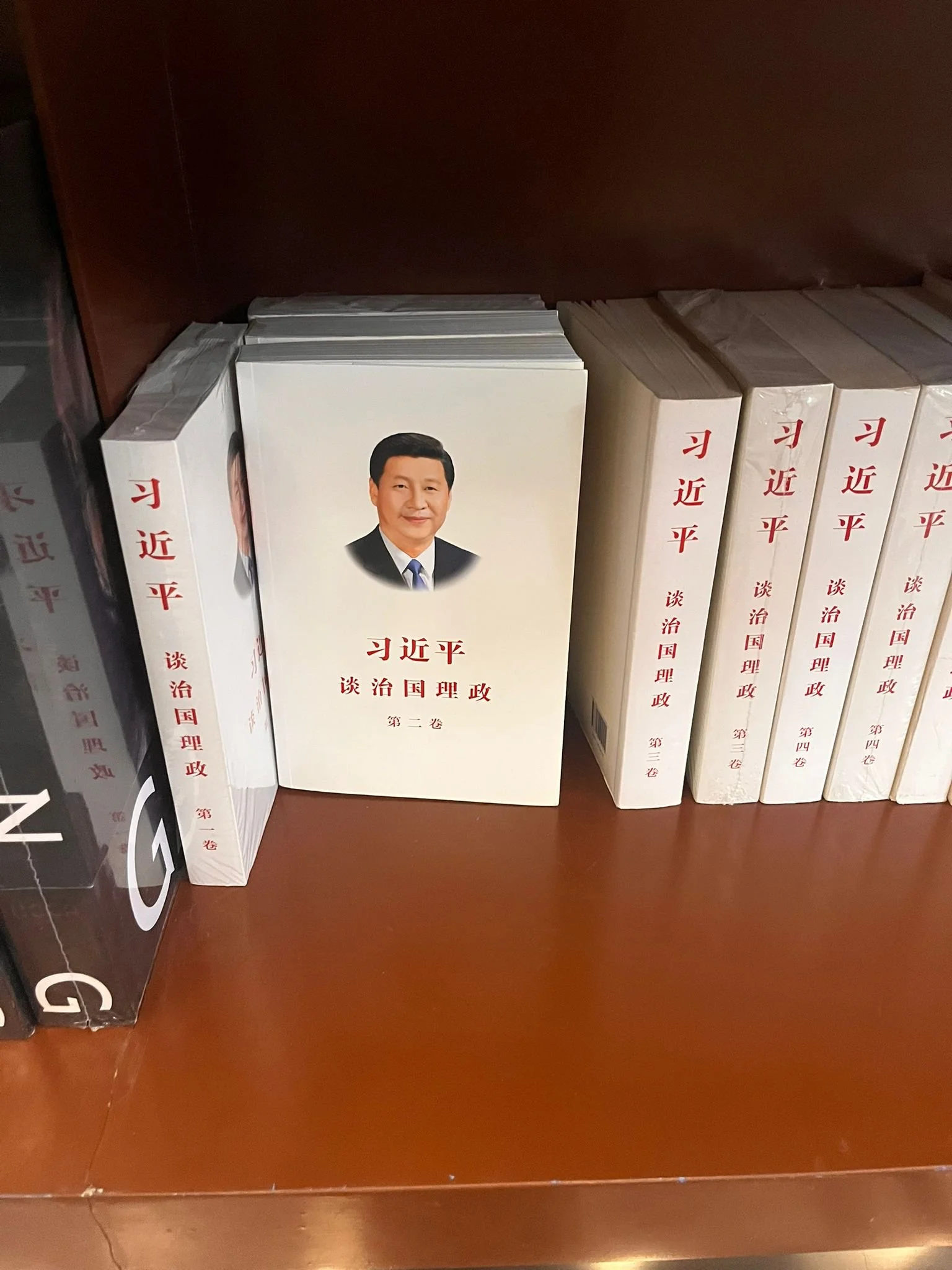
In bookstores, I noticed another version of this. There were displays of political texts, iterations of Chairman Xi’s version of the Little Red Book, and carefully presented narratives of Chinese history. I was also struck by seeing Lu Xun’s works prominently displayed, knowing how influential he was for Yu Hua and for shaping modern Chinese literary consciousness. It made me think about preservation, not just of culture, but of mindset, and how even that is guided.
There were moments where what I was reading and what I was seeing didn’t fully align, but instead of feeling like contradictions, I perceived them as different layers. For example, I kept thinking about temporality. So much of what I was reading in both books took place within the last hundred years, and yet when we walked through a museum, there were lots of artefacts dated to the Qing dynasty (1644-1911). It was framed in a way that felt almost compressed. My husband, coming from a European perspective, kept remarking on how recent the history felt there. It made me think about how “ancient China” is perceived differently depending on where you’re standing, and how events like the Cultural Revolution have also shaped what historical continuity looks like today—what is preserved, what is erased, and what is rewritten.
I also found myself comparing China to India in my head more than I expected. My sister had asked me while I was there, “Is it anything like India? That’s what I imagine.” And I realised I had similar assumptions. We often hear the two countries mentioned together in terms of population, growth, and global power, but being there made the differences feel just as significant. India may not feel as organised or controlled, but there is a different relationship to history, one that is more visibly layered, even if imperfectly preserved.
At the same time, I’m aware that I was viewing everything through my own lens: ‘Western’-educated, child of Indian immigrants, influenced by the kinds of narratives that are available to me. I took Jung Chang’s account with a grain of salt for that reason as well. She wrote it decades ago from the UK, and China today is not the same China of that book and of course it is only her family’s perspective. I kept thinking about a friend who lives in China, who told me that people living in cities today—sometimes described online as “living in 2050”—have witnessed one of the fastest technological transformations in the world within a single lifetime, another reminder that any version of China I was encountering was already partial, already shifting.
And then there’s the present. The version of China that is opening up, that we engage with globally, that exercises soft power in ways that are subtle but effective. Of course, not everything is open. Things are still banned. Knowledge is still controlled and released selectively. Just because the boundaries aren’t always visible doesn’t mean they aren’t there or that they couldn’t shift again.
All of this made the contrast between the two books even more striking.
Wild Swans insists on remembering. It documents, explains, and preserves a version of history that is not officially sanctioned. To Live, on the other hand, shows what it means to endure, perhaps that is why is it not banned and Yu Hua continues to enjoy life in China. To Live doesn’t question or analyse in the same way, it shows that life simply continues even as the most tragic and unimaginable things occur. Fugui’s story stayed with me. Some of the tragedies literally took my breath away. But more than that, it was the accumulation of loss that felt overwhelming. There is no resolution, no redemption arc, only survival.
Reading both books while traveling in China in 2026, more than thirty years after their publication, made me realise how much any understanding of a place depends on perspective: on what you read, what you’re told, and what you’re not told.
If I hadn’t read Wild Swans, my understanding of To Live would have been different. And if I had only experienced China through official narratives, that understanding would have shifted again. That, in itself, is a powerful realisation because that is the reality for most people.
I’m only a visitor, trying to understand a deeply complex place, aware of my own biases and trying to hold multiple versions of the same story at once, without collapsing them into a single, easy narrative. I don’t think I left with answers but somewhere between Chengdu and Beijing, between books and conversations and silences, I began to understand how many different versions of a place can exist at once and how much of that depends on who is allowed to tell the story.
I highly recommend reading both books as well as these ones which I’d read over the years and also helped shaped my understanding of modern China:
I look forward to continuing my journey into unpacking my trip to China with the following and would really welcome more suggestions or discussion:
China in Ten Words by Yu Hua and translated by Allan H. Barr
The Opium War: Drugs, Dreams, and the Making of Modern China Julia Lovell (I’ve already started this and don’t know if I’m liking it…)
Fly, Wild Swans: My Mother, Myself and China by Jung Chang (Recently published sequel to Wild Swans!)