‘There Will Come Soft Rains’ by Ray Bradbury
In 1950, Ray Bradbury published a short story called ‘There Will Come Soft Rains’ and guess when it’s set…August 4, 2026! I’m not gonna lie, I got immense satisfaction from re-reading this one today, life’s simple pleasures! I first read this when I was about 15 and completely obsessed with Bradbury and I am glad I came across this again just in time.
In this sci-fi short, Bradbury lays out the aftermath of a nuclear catastrophe: a wasteland, unfettered with humans. A ‘smart’ house with everything automated and scheduled, from tiny robot mice cleaners to a stove making eggs and bacon, persists. The only living thing that is allowed to enter the house is an emaciated dog who perishes soon after arriving home–the mice have much to do. As an aside, I recently watched The Odyssey and the dog in Bradbury’s story really reminded me of Argos. Him lying sick on a pile of dung is all I could picture.
The story’s personification of technology that seeks to triumph over nature in the midst of a nuclear wasteland displays the consequences of humanity for all to see. It’s foil: the persistence of nature as foxes, cats, and birds keep trying to fill the space left behind and the dog, who shows compassion and heartbreak, that which technology has no capacity for. Questions about whether the house is more sentient than we think linger amongst the words. It realises the residents aren’t coming back. Eventually a wind blows in a tree branch and a fire consumes most of the house. Nature prevails. 🌳🏔️
If you’re going to pick this one up (or search it up online, it’s short and open access), today’s the day! Short stories can be so artful, conveying so much with limited word count and this one’s one of my favourites. I used to read a lot more of them back in the day and might make a post of my favourites. Unfortunately though, most of the ones I’ve cherished are written by now-dead white men, so maybe I need to open up my repertoire. Any recommendations?
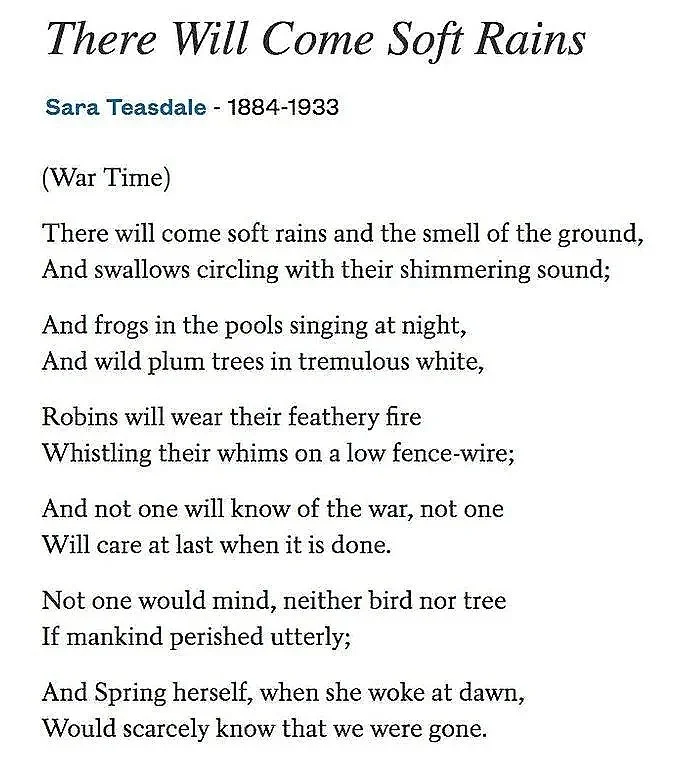
Ray Bradbury based this story off of Sara Teasdale’s poem.